Showing posts with label Sustainable Development. Show all posts

Wednesday, 21 May 2014

What could the future hold for the property industry?


Back in March, the students on the MSc Real Estate were invited to a 'Scenario Day' with Angus McIntosh (Visiting Professor in the Department of Real Estate and Construction) and Nick French (Professor in Real Estate and Director of the MSc RE).

The RICS Property Futures Initiative states:

'We live in a volatile, uncertain, complex, ambiguous and rapidly changing world. On the one hand people around the globe are becoming healthier, wealthier, better educated, more peaceful, increasingly connected and living longer. On the other, the world is more corrupt, congested, warmer, dangerous, divided and unemployed. The pace of change is increasing - as a review of the last two decades demonstrates. All of us have an interest in the world of tomorrow. We want to know where the jobs will be; what skills will be needed; how we will sustain our families and live well.'

The day consisted of a series of presentations and workshops and was a mirror of many of the events held by Angus McIntosh in work that contributed to the RICS Property Futures Initiative. The students benefited from the same workshop that many of the leading partners and directors of the global real estate consultancies undertook between 2008 and 2013. The idea of the day was not to find definitive answers but to think about, and be prepared for, the plethora of different scenarios that may turn out to be our actual future. Working to the adage....

'The future is a given uncertainty. Imagine tomorrow, decide today'

The students had to think through numerous possible outcomes; some positive, some negative. The idea being to have an idea on how real estate and property (and the profession) will need to adapt to each scenario.

On a slightly different note, envisaging how cities and the built environment will operate in the future is a really hot topic at the moment with many UK cities already constructing plans. Take a look at the following links for more information and inspiration:

RICS - scenarios - why a futures project?
UBM Future Cities - the global community for 21st century city decision makers
The Futures Academy - reports and papers
Future Cities Catapult - a global centre of excellence on urban innovation. A place where cities, businesses and universities come together to develop solutions to the future needs of our cities.
The Oxford Programme for the Future of Cities - rethinking the urban to face future challenges
Future City Glasgow - an ambitious programme which will demonstrate how technology can make life in the city smarter, safer and more sustainable.

Wednesday, 19 September 2012

Urban Resilience


Ramin Keivani (from DREC) took part in the Urban Resilience Networking Seminar at the World Urban Forum meeting in Naples on 6 September 2012. The seminar was organised by OISD and CENDEP, both based at Oxford Brookes.

So, what exactly is urban resilience? Turns out to be a very interesting and relevant subject. Let's start with the Wikipedia definition: the capability to prepare for, respond to, and recover from significant multi-hazard threats with minimum damage to public safety and health, the economy, and security of a given urban area. Wikipedia has lots more to say about urban resilience and is worth a closer look.

The focus of the World Urban Forum event was: Urban resilience - learning from experience and moving towards a more common understanding. Those that took part in the event debated different meaning and experiences of urban resilience in an attempt to contribute to a more common understanding of the subject. A number of key questions were discussed:

  • What do we mean by urban resilience?
  • How do we achieve it?
  • What do we need to achieve it?
  • How do we measure it?

Speakers at the event included:


There is a lot of research going on in this area. If you're interested in finding out more, take a look at the following websites:

Transitioning Towards Urban Resilience and Sustainability (TURAS)
Resilience Alliance
The Green Changemakers Blog
SEED
SUPER (a video on the Sustainable Urban Planning for Ecosystems Services and Resilience project)

An inspiring little video to finish with:


Monday, 17 September 2012

UK-Brazil Urban Network

2050 Vision: UK-Brazil Urban Network
Globalisation, climate change and urban governance: balancing the scales for both efficient and pro-poor urban futures – the case of Brazil and UK

OK, so what is it?
Ramin Keivani from the Department of Real Estate and Construction, together with colleagues from the Department of Planning established the network with funding from the Future of Cities programme which  is based at the University of Oxford.

The main aim of this network is to develop research capacity and facilitate transfer of knowledge on the interface between globalisation, climate change, urban development and urban governance in Brazil and UK and how this impacts on local economies, local livelihoods and access to resources. The network focuses on governance for sustainable futures and within this, the need to address climate change and promote pro-poor/socially inclusive strategies in an era of competitiveness. Cities around the world and particularly rising powers in Latin America are attempting to grapple with these issues and this comparative research will explore how these global processes are being played out in two contrasting countries.

The work will contribute to a better understanding of pro-poor and more sustainable urban governance both in terms of basic concepts and theories and policy and best practice, particularly in Brazil and UK. The outcomes and outputs will be of interest to researchers in a range of disciplines not directly involved in urban governance/development. These include urban economy, geography, urban sociology, area studies and development studies. Similarly we expect the research would be useful to a range of national and city level policy makers and consultancy firms particularly those involved in social policy, urban planning and economic development. For more information take a look at the UK-Brazil Urban Network website. The one year project also involves Sue Brownill from the Department of Planning, Idalina Baptista of Said Business School, Jeroen Klink and Rosana Denaldi from Universidade Federal do ABC (Santo Andre - Sao Paulo) and other experts from the UK and Brazil.

A project on Olympic Legacy has been developed as a result of the network activity and is being funded by Santander. Again this involves other members of OISD staff and colleagues from Brazil.

There have been a series of workshops in the UK and Brazil and the following are some photos from the most recent workshop that took place in June 2102 in Rio. All photos courtesy of the Urban Network.

Rio - the next Olympic City but at what cost?

Looking down on Rio City from Morro da Providencia Favela

These houses in Morro da Providencia have been marked for demolition as part of an upgrading programme. There is a major debate and political battle going on about favela upgrading and inclusive redevelopment in Rio.

More houses marked for demolition in Morro da Providencia.

Talking to local activists and community development officials in Morro da Providencia (Ramin is on the left )

Welcome to Vila Autodromo - a favela threatened with demolition as a result of plans for the 2016 Olympics site. 

Altair Guimaraes, head of the local community association in Vila Autodromo.

Vila Autodromo.
You still reading? Good. If you want to find out more about the Rio favelas, demolition, redevelopment and the issue of the 2016 Olympics then take a look at the following websites:

Rio On Watch
Olympics for all!
Favel Issues
One Planet Living

See what is actually going on by watching these two videos: the first features residents from Morro da Providencia and the second the residents of Vila Autodromo.


Thursday, 15 March 2012

Olympic Park Development


8 February 2012 

On 8 February the second year undergraduate students in Real Estate went on a tour of Stratford and Newham, London Docklands and the Olympic Park. This blog entry has taken a bit of time, but read on, it's worth it!

The field trip is part of the Integrative Project Module and gives students the opportunity to integrate the knowledge and experience gained over the first two years of the course by focusing attention on the potential development and investment opportunities created by the London 2012 Olympic Games. Students work in teams throughout the module to produce a number of outputs based on the field trip including: an architect's concept poster; an investment/development report and a marketing video.

One important aspect of the module is to give the students the opportunity to examine different aspects of the built environment and explore different approaches towards creating sustainable environments. Where better to start than the radical redevelopment taking place in Stratford and Newham and the London Docklands? By the time of the 2012 Olympics the transformation will be complete, but that is not the end of the story. When the 2012 Olympics draws to a close it will leave behind a very different East End of London and one which is determined to use the opportunities the 2012 Olympics has brought to bring about a renaissance that will be of lasting benefit to the communities that live there. For more information on the redevelopment of Stratford and Newham have a look at the Stratford: London website.

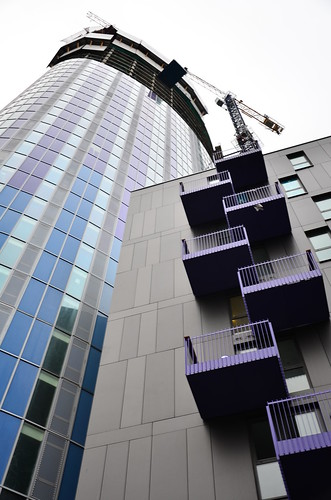
Tower Blocks in Stratford - photo by Ben Sutherland via Flickr

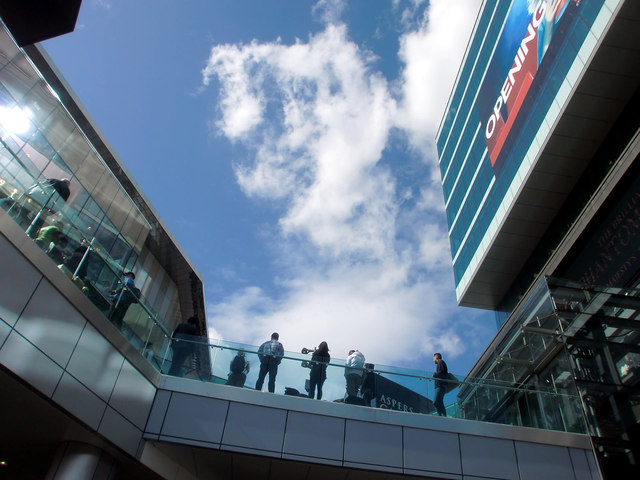
Stratford Westfield Shopping Centre - photo from Geograph UK
The Olympic Park itself is an excellent example of brownfield development. The site is being transformed from a brownfield site characterised by vast areas of derelict industrial land into a new urban park with improved infrastructure and a sustainable new quarter of London for the community to live work and play in after the 2012 Olympics (taken from the Olympic Delivery Authority: From Brown to Green - Transforming the Olympic Park - take a look it's a good document).

Artists Impression of the Olympic Park - photo by Estates Gazette via Flickr

Tuesday, 13 March 2012

Visit to the Building Research Establishment

Wednesday 7 March 2012

As a follow-up to their visit to the Olympic Park and London Docklands in February, the second year undergraduate students in Real Estate Management went on a visit to the Building Research Establishment (BRE) as part of their Integrative Project module. The aim of the Integrative Project Module is to give the students an opportunity to integrate the knowledge and experience gained over the first two years of the course by focusing attention on the potential development and investment opportunities created by the London 2012 Olympic Games. The module is designed to get students thinking and is supported by a number of guest lectures and seminars with lots of opportunities for discussion and for the practical application of research tools.

Why the visit to BRE?
One important aspect of the module is to give the students the opportunity to examine different aspects of the built environment and explore different approaches towards creating sustainable environments. The BRE Group has a history stretching back over 90 years, which has seen the bringing together of a number of separate research, testing and approvals organisations during that time. They provide a complete range of consultancy, testing, certification, commissioned research and training services covering all aspects of the built environment and associated industries.

At their main site in Watford, BRE also have an Innovation Park and it was this that the students went to investigate. The students were given a presentation about BRE's role at the forefront of sustainable homes research in the UK and were then given the opportunity to explore the test buildings on the Innovation Park. There are a wide variety of sustainable houses on site, but the only one on the market so far is the Cub House (the white cube) which is available as a one, three or five bedroom house. This modular home is made in England by FutureForm and can be manufactured offsite in 16 days, with 7 days onsite construction and installation. Check out the Cub website for more details. The other buildings are fully functional but not yet on the market - the high standard of furnishing suggests that these test buildings are being used to attract developers and investors. For more details of all the houses look at the BRE Innovation Park website.

Inside the Cub House - photo by George Haines, 2nd year student on BSc REM

Cub House Bath - photo by George Haines, 2nd year student on BSc REM

Cub House Kitchen - photo by George Haines, 2nd year BSc REM

The Prince's House - photo by George Haines, 2nd year BSc REM

BRE are also involved with the Passivhaus building competition in which designers were challenged to create a demonstration building that is both affordable and Passivhaus certified. The winning design will be built on the Innovation Park during 2012. Take a look at the results of the 2012 Passivhaus competition and find out what a Passivhaus is and how this type of housing can benefit the environment and residents.